ETL vs ELT: the difference and when to use each
ETL transforms before loading; ELT loads raw data and transforms it in the warehouse. See the difference in a table, when each pays off, and EtLT.
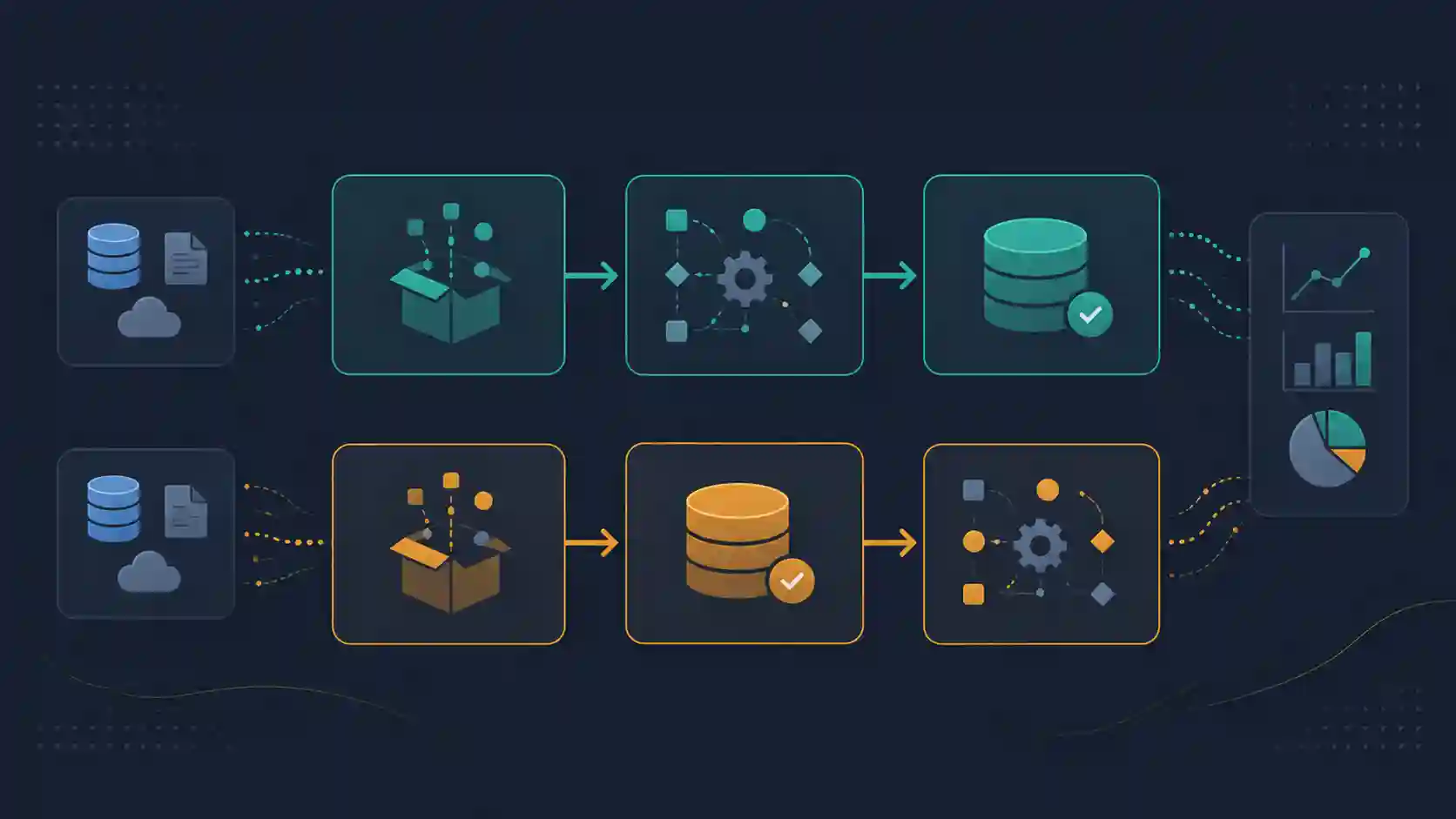
In an architecture review, someone asked why the pipeline was loading raw files straight into the warehouse before transforming them. The answer was "it's ELT, not ETL". The silence in the room made it clear that half the team had never thought about the difference, and the other half assumed it was just the order of the letters.
It isn't. ETL transforms data before loading it into the destination; ELT loads raw data and transforms it inside the warehouse itself. The order decides where the heavy computation happens, what it costs, and whether the original data survives a logic bug. This post shows the difference in a table, when each model pays off, and the hybrid that almost every real pipeline ends up using.
The difference between ETL and ELT
ETL (Extract, Transform, Load) is the classic model. You extract data from the source, transform it in an intermediate layer (a processing server or job), and only then load the clean, structured result into the destination.
ELT (Extract, Load, Transform) swaps the last two steps. You extract, load the data raw into the destination, and the transformation runs inside the warehouse, using its compute.
ETL: Source → [Server/job: transforms] → Warehouse (clean data)
ELT: Source → Warehouse (raw data) → [Warehouse: transforms in place]
The practical difference isn't philosophical: it's where the computation happens and what gets kept.
| ETL | ELT | |
|---|---|---|
| Order | extract, transform, load | extract, load, transform |
| Where the transformation runs | a server or job outside the destination (Python, Spark, an integration tool) | inside the warehouse, in SQL (dbt, native SQL) |
| Raw data kept in the destination | no, only the result | yes, in a raw/bronze layer |
| Reprocessing with new logic | requires extracting from the source again | rewrite the SQL and rerun it over the raw data |
| PII and GDPR/LGPD | masked before reaching the destination | sensitive data arrives raw, unless there's a step before the load |
| Main cost | your own processing infrastructure | warehouse compute, billed by usage |
| Typical tools | Informatica, SSIS, Spark, Python scripts, Airflow | Fivetran or Airbyte (EL) + dbt (T) |
| Best fit | chaotic sources, strict compliance, a limited destination | elastic warehouse, SQL-fluent team, rules that change |
Why ETL dominated for so long
ETL was the natural answer when the warehouse was an expensive appliance, with storage and compute sold together and sized for peak load. Leaving dirty data in there wasted paid capacity. It made sense to preprocess on a dedicated server and load only the finished product: validated, typed, with a defined schema.
The problem is that the transformation logic lives far from the data. When the business rule changes, and it always does, you change the ETL code, extract the history from the source again (if the source still has it), reprocess, and hope the maintenance window fits the SLA.
Why ELT makes more sense in modern pipelines
The shift came with cloud warehouses that separate storage from compute and bill compute by usage. Storing raw data became cheap; processing is what costs money. The billing model varies, and it's worth knowing yours (public pricing checked on 2026-11-09):
- BigQuery on-demand bills by bytes processed per query: US$6.25 per TiB, with the first TiB each month free (pricing). Under the capacity model, you pay for slots per hour instead of bytes.
- Snowflake bills credits for the time a virtual warehouse is running, per second, with a 60-second minimum each time it starts; credits per hour double with each warehouse size (docs).
- Redshift provisioned bills per node-hour; Serverless bills RPU-hours per second, with a 60-second minimum (pricing).
- Databricks bills DBUs (a normalized unit of processing) per second, depending on the compute type (pricing).
That made loading first and transforming later cheaper and more flexible:
You keep the original data. If the transformation logic is wrong, the raw data is still there. You fix the SQL and reprocess without going back to the source, which may no longer keep that history.
The transformation uses the warehouse engine. Aggregating billions of rows is what BigQuery and Snowflake do well, and you don't keep a processing cluster idle waiting for the overnight job.
Faster iteration. With dbt, the transformation is SQL versioned in Git, with tests and documentation. You change a rule, run dbt run, and the result is updated without deploying a server.
When ETL still makes sense
Compliance and privacy (GDPR, LGPD). If the raw data contains national ID numbers, card numbers or health data and the warehouse isn't an environment approved to hold it, the transformation (masking, tokenizing, dropping columns) has to happen before the load.
Heterogeneous, dirty sources. Fixed-width files, APIs that change shape, legacy FTP, CSVs with unpredictable encoding: sometimes normalizing outside the warehouse, in Python, is saner than fighting all of it in SQL. Encoding, BOM and delimiter problems, for instance, are solved when reading the file, as I show in how to import CSV files without corrupting characters; a file too big for memory calls for streaming reads, as in large CSV in JavaScript.
Repeated transformations over large volumes, billed per byte. On BigQuery on-demand, a model that rereads a 2 TiB raw table every hour processes about 1,440 TiB in a 30-day month: close to US$9,000, before any optimization. Partitioning, incremental materialization or pre-aggregating before the load cuts that down; sometimes the right answer is to transform outside and load less.
Data ready in seconds. If the consumer needs the enriched event in near real time, the answer isn't "faster ETL", it's stream processing, with the transformation in the middle of the flow. The difference is in data streaming vs batch processing.
The hybrid model you see in practice (EtLT)
Real pipelines are rarely pure ETL or pure ELT. What you find in production looks more like this:
- Extract: pull from the source (API, OLTP database, files).
- Light transform: the minimum needed before persisting, such as encoding, key deduplication and PII masking.
- Load raw: load into the warehouse's raw/landing layer.
- Heavy transform: the analytical transformations inside the warehouse, with dbt or native SQL.
This model was popularized by architectures like Databricks' Medallion (Bronze/Silver/Gold) and dbt's staging/marts layers. The raw data kept in Bronze is the reprocessing point, and the layers above refine it step by step.
-- dbt model in the silver layer (Snowflake/Redshift dialect)
-- The raw data is already in the warehouse; the logic lives in versioned SQL
SELECT
    order_id,
    customer_id,
    -- the amount arrived as text with a decimal comma ("149,90")
    CAST(REPLACE(raw_amount, ',', '.') AS DECIMAL(10,2)) AS amount,
    -- order_ts was stored without a time zone, in São Paulo time
    CONVERT_TIMEZONE('America/Sao_Paulo', 'UTC', order_ts) AS order_utc
FROM raw.orders
WHERE order_id IS NOT NULL
Two things to watch in that SQL. First, the source time zone: the two-argument form, CONVERT_TIMEZONE('UTC', order_ts), treats a timestamp without a time zone as if it were in the session's time zone, according to the Snowflake documentation; if the session isn't the source's, the result is shifted with no error at all. Always state where the time comes from (the full trap is in timestamps without time zone). Second, REPLACE only works if the source never sends a thousands separator: "1.999,00" becomes "1.999.00" and the cast fails. I ran the equivalent logic in Postgres (AT TIME ZONE) against three test rows: 149,90 at 21:30 São Paulo time became 149.90 at 00:30 UTC the next day, and the row without an order_id dropped out of the result.
The role of modern tools in this choice
ELT owes much of its popularity to dbt. Before it, doing ELT meant loose SQL, with no versioning, no tests, no documentation. dbt brought Git, CI and tests to transformation.
On the other side, extraction tools like Fivetran, Airbyte and Stitch automated EL, leaving transformation as the part that needs your own code. The classic picture was "Fivetran or Airbyte does EL, dbt does T", with different companies on each side. That changed: Fivetran and dbt Labs announced a merger on 2025-10-13 and completed it on 2026-06-01, operating as Fivetran + dbt Labs, according to the official press release. At the same time, the dbt Fusion engine runtime was open-sourced as dbt Core v2.0, in alpha, under the Apache 2.0 license. Stitch, for its part, is now part of Qlik, which is folding it into Qlik Talend Cloud. In practice, EL and T now have the same owner in the market's most common pairing, which is worth weighing when you assess vendor lock-in.
ETL didn't die because of this. Spark, Flink and streaming frameworks still transform before the load when the case calls for it, especially to enrich or aggregate events before persisting them.
When ELT scales badly
If you load raw data without any quality control, the warehouse turns into a data swamp: raw tables with inconsistent schemas, duplicates, nulls where there shouldn't be any, and cleanup logic scattered across dozens of ownerless dbt models.
The discipline ETL forced had a good side effect: bad data was caught before it got in. With ELT, detection has to be explicit: dbt tests (not_null, unique, relationships), data contracts and validation at extraction. It's the same principle as validating data before saving it to the database, applied to the pipeline. And if the question is the destination itself, a columnar warehouse isn't your application database; choosing the transactional database is a different topic, covered in relational vs NoSQL.
ELT with discipline beats ETL. ELT without discipline is worse than any alternative.
Frequently asked questions
ETL or ELT: which is faster to implement?
For a source covered by a ready-made connector and a cloud warehouse, ELT with Fivetran or Airbyte plus dbt is usually running within hours. For integrating dozens of heterogeneous sources with complex rules, an ETL in Python or Spark can be easier to maintain, especially if the team knows those languages better than analytical SQL.
Can I use dbt with ETL?
dbt runs SQL inside the warehouse, so it is by definition the T in ELT: the data has to be loaded before dbt run. Nothing stops you from having a light transformation step before the load and dbt afterwards; that's EtLT.
What is EtLT?
It's the name of the hybrid model: a light transformation before the load (masking PII, deduplicating, fixing encoding) and the full analytical transformations inside the warehouse. Most production pipelines are already EtLT, even when the team doesn't use the term.
Do I need a dedicated server for ETL?
No. ETL can run on serverless functions for small volumes, or in containers orchestrated by Airflow, Dagster or Prefect for larger ones. The dedicated server was needed when infrastructure wasn't elastic; today transformation can run on demand, with no fixed cost.
The right architecture depends on where compute is cheapest
"ETL or ELT?" matters less than "where is the transformation cheapest, easiest to maintain and most reliable?". If the warehouse is elastic and the team knows SQL, ELT with dbt is the default choice, with tests from the first model. If there's PII that can't arrive raw or the sources are too chaotic, transform first, at least the minimum. And check your warehouse's billing model before scheduling a model that rereads the whole table every hour.
The editorial content ends here. Before defining the raw layer schema, I usually take a sample of the CSV exported from the source and run it through the Quick Tools CSV to JSON converter, which runs in the browser without sending the file to a server: seeing each row as an object makes it obvious which column arrives as text, empty, or with a decimal comma.
- 01 CPU Cores vs. Threads: What Actually Changes in Practice Understand the difference between CPU cores and threads and what actually changes for performance, multitasking, gaming, and development.
- 02 MIT, Apache, and GPL Licenses: Practical Differences for Developers MIT, Apache 2.0, and GPL are not the same thing. Understand permissive vs copyleft, patent protection, and compatibility before shipping code to production.