Mid-Market Rate: The Exchange Rate Banks Don't Pass On (and What That Costs)
Compare your bank's quote with the mid-market rate, work out the spread in percent and add Brazil's 3.5% IOF to see what a currency conversion really costs.
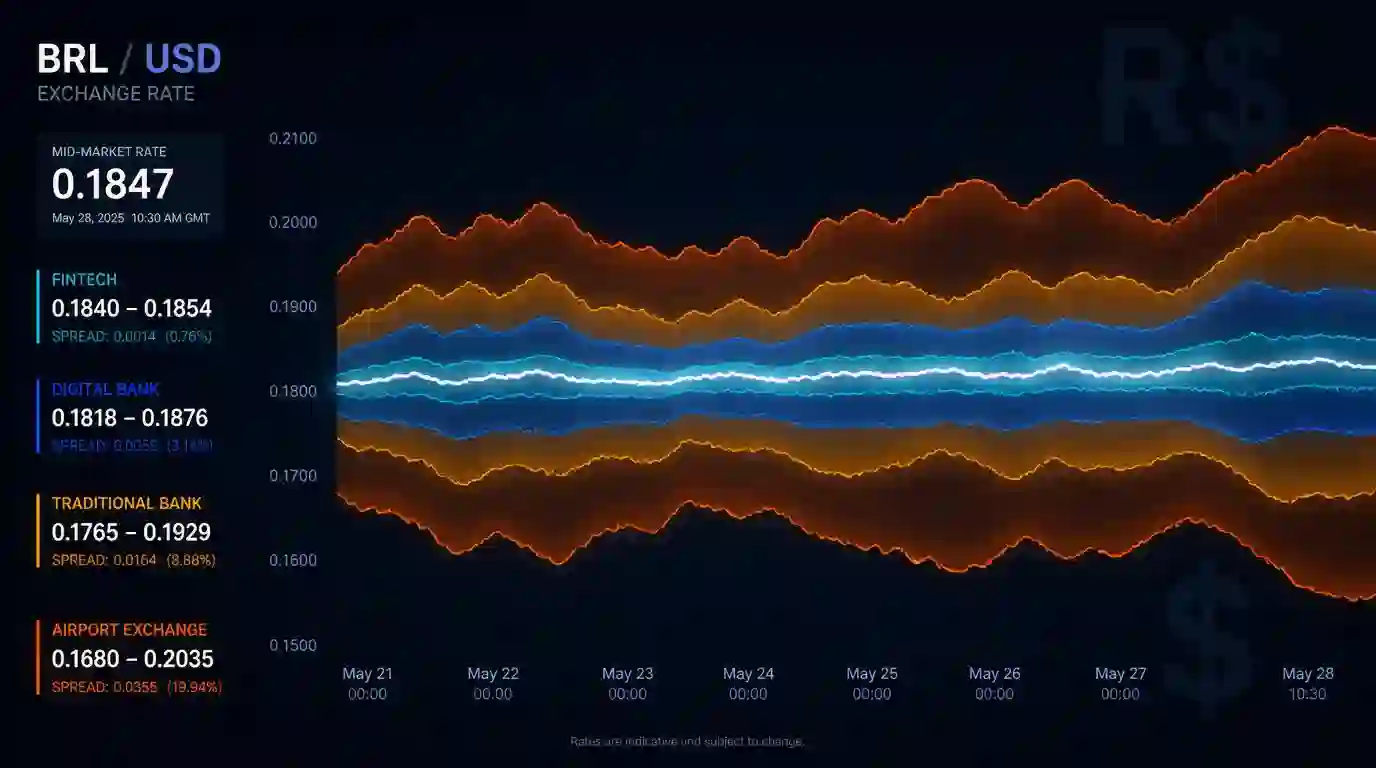
I worked at a fintech for two years. Every week someone asked why the dollar rate in our API was different from the one Google showed. Sometimes it was a customer, sometimes someone from product convinced there was a bug. It was never a bug: it was spread. And almost nobody remembered the second half of the bill, the tax on the conversion itself, which in Brazil in 2026 weighs more than the spread of many digital banks.
This post shows how to calculate the real cost of a currency conversion: the reference rate that works as a ruler (mid-market, and Brazil's PTAX), the spread formula in percent, the Brazilian IOF tax for each type of operation, and the VET, the single number that adds it all up. The examples use a reference of R$ 5.50 per dollar, rounded from November 2026 quotes: a PTAX selling rate of R$ 5.5013 on 2026-11-06 (Banco Central do Brasil) and an ECB reference rate of R$ 5.5167 on 2026-11-09. Swap in the numbers for the day you actually convert.
What the mid-market rate is (and where PTAX fits)
Every currency market has two prices at the same time: what someone pays to buy the currency (bid) and what someone charges to sell it (ask). The mid-market rate is the midpoint between the two. It's what Google, Reuters and currency converters show, and it's the fairest ruler for measuring what a service charges, because it doesn't lean to either side.
In Brazil, the official reference is PTAX. The Central Bank polls FX dealers four times a day and publishes the average, with a buying rate and a selling rate. PTAX isn't exactly mid-market (it's two rates, and the gap between them is tiny), but in practice they sit within cents of each other. For comparing offers either works; what matters is using the same ruler for every comparison.
No bank deals with retail customers at these rates. The distance between the reference and the quote you get is the spread, the institution's margin built into the price.
How to calculate the exchange rate spread
Direction matters, and it's where many explanations get it wrong. When you buy dollars, the bank sells above the reference. When you sell dollars (you got paid from abroad and convert to reais), the bank pays below it. The two formulas:
buying currency:   spread % = (offered rate − reference) / reference × 100
selling currency:  spread % = (reference − offered rate) / reference × 100
Buying example: reference at R$ 5.50 and the bank selling at R$ 5.72.
(5.72 − 5.50) / 5.50 × 100 = 0.22 / 5.50 × 100 = 4.00%
Selling example: reference at R$ 5.50 and the bank paying R$ 5.39 per dollar you received.
(5.50 − 5.39) / 5.50 × 100 = 0.11 / 5.50 × 100 = 2.00%
If you'd rather not do it by hand, a percentage calculator handles it with the percent change between two values.
A warning about "zero fees": whoever doesn't charge a visible fee almost always charges through the spread. The reverse model exists too. Wise, for example, says it converts at the commercial rate "the same one you see on Google" and charges an explicit fee, starting at 0.4% depending on the currency (pricing page, checked November 2026). To compare one model with the other, turn everything into a total cost in reais, which is what the next sections do.
Spread + IOF: the total cost of a conversion in Brazil
Brazil's IOF on foreign exchange is charged on the value in reais of the operation, and the rate depends on the type. The current rates come from art. 15-B of Decree 6,306/2007, as amended by Decree 12,499 of June 11, 2025:
| Operation | IOF | Art. 15-B item |
|---|---|---|
| Purchases abroad with an international credit or debit card | 3.5% | VII |
| Cash withdrawals abroad with a card | 3.5% | IX |
| Loading an international prepaid card, traveller's cheques | 3.5% | X |
| Buying foreign cash | 3.5% | XX |
| Transfer to your own account abroad | 3.5% | XXI |
| Transfer abroad for investment purposes | 1.1% | XXI-A |
| Other outbound transfers | 3.5% | XXIV |
| Export revenue for goods and services (inbound) | zero | I |
| Other inbound funds from abroad | 0.38% | XXV |
A note on whether this is in force, because it was a fight. Congress suspended the increase with Legislative Decree 176/2025, and on 2025-07-16 Justice Alexandre de Moraes of the Supreme Court (STF) reinstated the decree from its original date, except for the part on "risco sacado" (supplier-finance operations), which doesn't affect personal FX (STF news, ADC 96). It's an interim ruling and the full court has yet to decide the merits; since IOF rates change by decree, check before you convert.
With IOF included, the total cost of buying currency is:
total cost in R$ = amount in currency × offered rate × (1 + IOF) + fees
cost over reference % = total cost / (amount in currency × reference) − 1
VET: the number the bank has to show you
Comparing spread, fees and IOF separately is tedious. Brazil's Central Bank already solved this with the VET (Valor Efetivo Total, effective total value): how many reais you pay per unit of foreign currency, adding exchange rate, taxes and fees. BCB Resolution 277/2022, art. 18, defines the VET and requires the institution to tell the customer before the operation, for spot operations up to US$ 100,000.
In practice: ask the exchange office, the bank and the fintech for the VET, and compare VETs. It's the only number that already includes everything. The Central Bank also publishes a monthly ranking of the average VET charged by authorized institutions, going back to May 2013. For card payments abroad the logic is the same, except the issuer's rate and the IOF show up on the statement.
The cost in actual numbers
Every calculation below uses the R$ 5.50 reference. The spreads are hypothetical, to show the effect; your bank tells you the real one (or you work it out with the formula above).
Spending USD 1,000 abroad on a credit card (IOF 3.5%):
| Issuer spread | Rate | Converted | IOF | Total | Over reference (R$ 5,500) |
|---|---|---|---|---|---|
| 1% | 5.5550 | R$ 5,555.00 | R$ 194.43 | R$ 5,749.43 | R$ 249.43 (4.54%) |
| 2% | 5.6100 | R$ 5,610.00 | R$ 196.35 | R$ 5,806.35 | R$ 306.35 (5.57%) |
| 4% | 5.7200 | R$ 5,720.00 | R$ 200.20 | R$ 5,920.20 | R$ 420.20 (7.64%) |
Notice that on the 1% card, the IOF (R$ 194.43) costs more than three and a half times the spread (R$ 55.00). Switching banks shrinks the smaller part of the bill.
Converting R$ 10,000 into dollar cash (IOF 3.5%). With R$ 10,000 in total, the amount that actually goes into the exchange is R$ 10,000 / 1.035 = R$ 9,661.84; the rest is IOF.
- At the reference, with no spread and no IOF: USD 1,818.18.
- 2% spread (R$ 5.61) + IOF: USD 1,722.25, or USD 95.93 less (5.28%).
- 4% spread (R$ 5.72) + IOF: USD 1,689.13, or USD 129.05 less (7.10%).
- 8% spread (R$ 5.94) + IOF: USD 1,626.57, or USD 191.61 less (10.54%).
The VET for those three cases: 5.61 × 1.035 = R$ 5.8064; 5.72 × 1.035 = R$ 5.9202; 5.94 × 1.035 = R$ 6.1479.
Larger amounts: R$ 50,000 converted at a 2% spread buys USD 8,912.66 (50,000 / 5.61); at a 4% spread, USD 8,741.26 (50,000 / 5.72). The difference is USD 171.40, about R$ 942.68 at the reference, before IOF, which applies equally to both.
Two cases where the spread changes the decision
A SaaS subscription in dollars on the company card. USD 2,000 a month, a card with a 4% spread versus one with 1%. The spread difference is 3% of 2,000 × 5.50 = R$ 330.00 a month; since the 3.5% IOF is charged on the converted amount, the final difference is R$ 341.55 a month, R$ 4,098.60 a year. The IOF itself (between R$ 389 and R$ 401 a month at that amount, depending on the spread) is paid on both cards; the card choice only moves the spread.
A freelancer paid from abroad. USD 3,000 a month, converted at a 1% spread (R$ 5.445) versus 2.5% (R$ 5.3625): R$ 16,335.00 versus R$ 16,087.50, a difference of R$ 247.50 a month, R$ 2,970 a year. Here the IOF is small: export revenue for services has a zero rate (item I), and inbound money that doesn't fit that category pays 0.38% (item XXV). The bank classifies the nature of the operation in the FX contract; check that it went in as a service export.
The places where the spread tends to be higher are predictable: airport exchange desks and dynamic currency conversion (DCC), when a card terminal abroad offers to charge you "in reais". Decline DCC and pay in local currency: the merchant's conversion comes with its own margin, and you lose the chance to compare it with your card issuer's rate.
Frequently asked questions
What is the mid-market rate?
It's the midpoint between the buying and selling price of a currency on the interbank market, the quote you see on Google and in converters. Nobody deals with individuals at that rate; it's the ruler for measuring the spread each service charges.
Is the exchange rate spread illegal?
No. It's the institution's margin and it's allowed. What the rules in Brazil require is transparency: the bank or broker must disclose the VET before closing operations up to US$ 100,000, already adding rate, fees and IOF.
What is the IOF on international card purchases in 2026?
3.5% on the converted amount, for credit, debit and prepaid cards, under Decree 12,499/2025, in force through the STF ruling of July 2025. The same rate applies to buying foreign cash and transfers to your own account abroad.
Is PTAX the same as the mid-market rate?
Almost. PTAX is the Central Bank's official rate, calculated from dealer polls during the day and published with a buying and a selling value. The mid-market rate is the market midpoint in real time. For measuring spread, both give very similar results.
Compare the VET, not the advertised rate
The spread is only part of what a currency conversion costs; for card purchases and foreign cash, the 3.5% IOF often weighs more. Before converting, get the day's reference, calculate the spread with the formula for the right direction, add IOF and fees, and compare the VET of each option. To have the reference at hand, I use the currency converter: it shows the ECB reference rate, published once per business day. It isn't a live quote, but it's the ruler you need to know whether the bank's offer is reasonable. If the next step is investing what's left, the post on how much to invest per month to reach a goal does that math.
- 01 CPU Cores vs. Threads: What Actually Changes in Practice Understand the difference between CPU cores and threads and what actually changes for performance, multitasking, gaming, and development.
- 02 MIT, Apache, and GPL Licenses: Practical Differences for Developers MIT, Apache 2.0, and GPL are not the same thing. Understand permissive vs copyleft, patent protection, and compatibility before shipping code to production.