What DevOps means in practice: culture, DORA metrics, and myths
DevOps is not a job title or a pipeline: it is dev and ops sharing responsibility for production. See the five DORA metrics, the myths, and what blocks change.
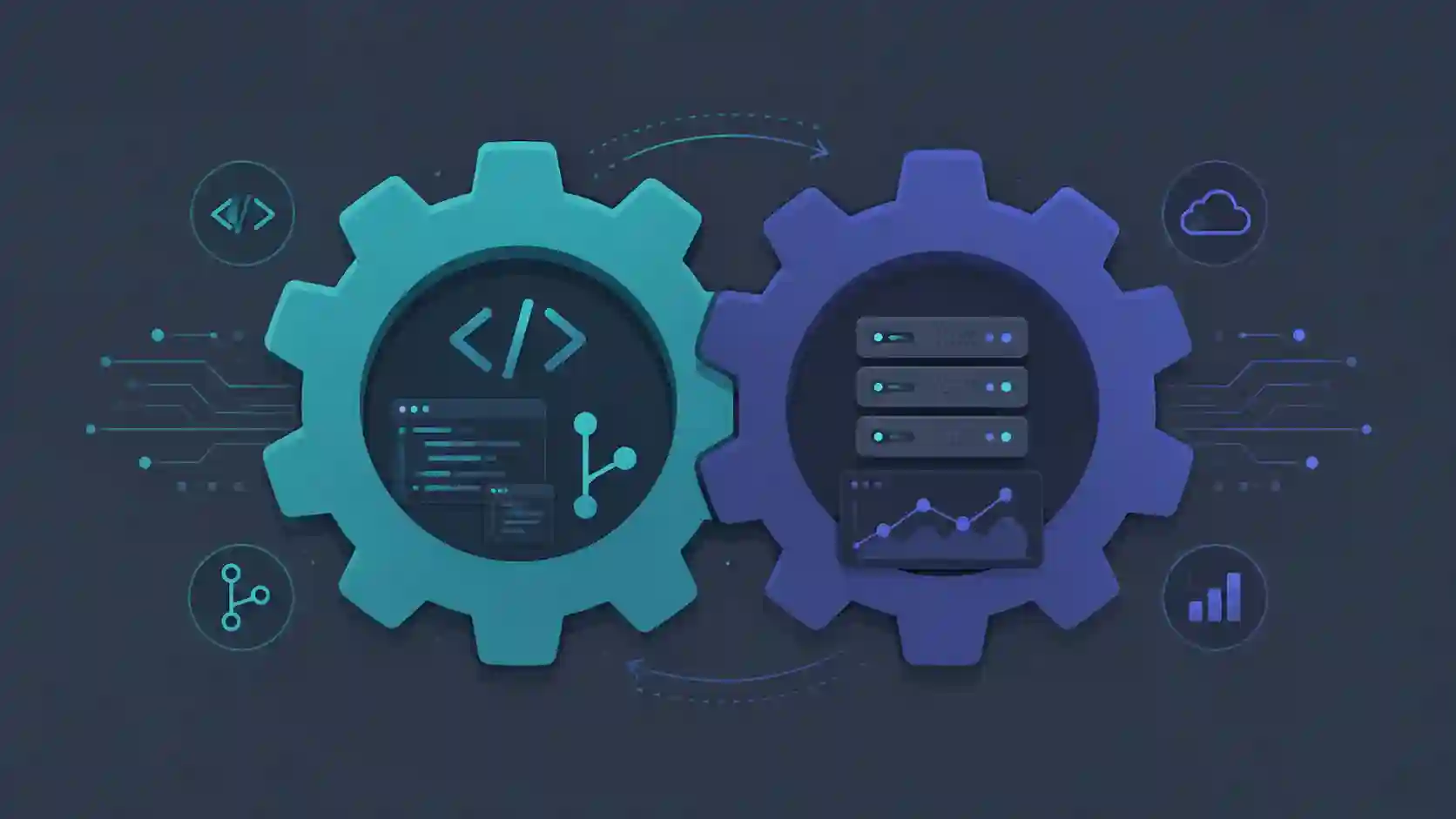
At an infrastructure kickoff meeting, the platform engineer said the team needed to "adopt DevOps." Three weeks later there was a configured Jenkins, a GitLab pipeline, and a metrics dashboard nobody opened. The problems were the same as before: Friday 5 p.m. deploys, bugs that only show up in production, dev and ops talking through tickets. New tools, old culture.
DevOps is a set of practices and, before that, a way of organizing work in which the people who build software and the people who operate it share responsibility for what runs in production, shipping small, frequent, measured changes. The term appeared in 2009, when Patrick Debois organized the first DevOpsDays in Ghent, Belgium.
This post is about what that means in practice: where the idea came from, the five DORA metrics that tell you whether it is working, the myths that make teams buy tools thinking they bought DevOps, and what blocks the change.
Where DevOps came from
The history is short and worth getting right, because a lot of material scrambles it. In June 2009, John Allspaw and Paul Hammond of Flickr gave the talk "10+ Deploys per Day: Dev and Ops Cooperation at Flickr" at the Velocity conference, showing that dev and ops could work together to deploy more than ten times a day without sacrificing stability. Patrick Debois, who had been talking about agile infrastructure management, organized DevOpsDays in Ghent in October of that year, and the event's name became the movement's name.
The books came later. The Phoenix Project, by Gene Kim, Kevin Behr, and George Spafford, is from 2013 and popularized the idea as a novel. Accelerate, by Nicole Forsgren, Jez Humble, and Gene Kim, came out in 2018 and consolidated the data from the research now called DORA. So the book is not the origin; it is the outreach.
And the phrase that sums it all up, "you build it, you run it," is not Jeff Bezos's. It is Werner Vogels's, Amazon's CTO, from an interview with Jim Gray published in ACM Queue in May 2006. He describes the traditional model, where software is thrown over the wall between development and operations and forgotten, and contrasts it with Amazon's: the team that builds the service is the team that runs it, which puts developers in contact with the day-to-day operation of their software. Three years before the word DevOps existed.
DevOps is not a job title or a pipeline
The most common mistake is treating DevOps as a role or a stack. The company creates a "DevOps Engineer" position and dumps CI/CD, containers, monitoring, and cloud on it. The development team keeps doing what it did. So does operations. Except now there is a third silo in the middle, with a Jenkins.
The bottleneck the movement attacked was never technology. It was the organizational split between whoever writes the code and whoever puts it in production. When dev and ops are silos, incentives are opposed by definition: dev is measured on shipping fast, ops on keeping everything up. The result is the classic cycle: dev throws code over the wall, ops tries not to break production, and each side blames the other when something fails.
DevOps tries to fix that with shared responsibility. Tools come as a consequence: you automate the deploy because the team that suffers from manual deploys is the same team that writes the code, not because a consultant recommended it.
DORA metrics: the five that measure DevOps in practice
DORA (DevOps Research and Assessment) is the research program that has measured software delivery performance for more than a decade; the first study dates from 2014 and the program is now part of Google Cloud. For a long time it was known for the "four metrics," with MTTR among them. That is outdated. The current dora.dev guide uses five, split into two groups:
| Group | Metric | What it measures |
|---|---|---|
| Throughput | Change lead time | Time from commit to the change being in production |
| Throughput | Deployment frequency | How often the team deploys |
| Throughput | Failed deployment recovery time | How long it takes to restore service after a failed deployment |
| Instability | Change fail rate | Share of deployments that need urgent intervention (rollback, hotfix) |
| Instability | Deployment rework rate | Share of deployments that are unplanned, made because of a production incident |
Two changes explain the difference from what you may have read. In the 2023 report, MTTR was renamed and redefined as failed deployment recovery time, to separate failures caused by the team's changes from external ones, like a data center outage. In the 2024 report the fifth metric, deployment rework rate, was added, and the five were regrouped into throughput and instability, according to the metrics history on dora.dev itself.
The most important finding of the research is still the same: the best teams do not trade speed for stability. The guide says top performers do well across all five metrics at once, and low performers do poorly across all of them. That does not happen because of better tools. It happens because the feedback loop between writing code and seeing its effect in production is short, and small changes are easier to test, review, and undo. How you split work into branches weighs heavily on lead time, the subject of branching strategies.
To start measuring, you do not need a platform. A pipeline that records the commit timestamp and the deploy timestamp already gives you lead time and frequency. Change fail rate and rework rate require incidents to be recorded and linked to the deploy that caused them. If you have none of this data today, that is the first step: measure before you optimize.
The myths that persist
"DevOps means devs also do ops." Partly. The dev does not need to become a network engineer or a kernel specialist. What changes is that they have visibility into what happens in production and responsibility for the service they wrote: observability, alerts, a basic runbook. That is not the same as being on call for the entire infrastructure.
"CI/CD is DevOps." CI/CD is a practice that enables DevOps. You can have a flawless pipeline and a deploy approval process that takes five days and needs sign-off from three managers. Technically, CI/CD. Culturally, the opposite. And the pipeline only gives confidence if its tests are good, the subject of the testing pyramid and of automated API testing.
"You need Kubernetes to do DevOps." A two-dev team on a VPS, deploying with git push and a systemd service, practices DevOps better than a twenty-person team with Kubernetes run by a separate group that holds a weekly change-approval meeting. Infrastructure complexity is not a measure of maturity. Containers help a lot with reproducibility, and a dev environment identical for everyone with Docker Compose is a good first step, but they are not a prerequisite.
"DevOps fixes communication between teams." Not directly. It targets the specific problem between dev and ops. If the friction is between product and engineering, or between engineering and security, that is organization and process, and DevOps does not touch it.
What blocks the cultural change
On the teams where I saw the change work, the turning point was the same: someone with authority decided the development team is responsible for what is in production. Fully, not partly. What blocks that decision, in practice:
Change management inherited from ITIL. Boards that approve deploys by hand, monthly maintenance windows, rollbacks that need a ticket. It has legitimate roots in regulated environments, but applied indiscriminately to web services it becomes a process cost larger than the risk it was meant to reduce. DORA's research, incidentally, found no evidence that external change approval lowers the change fail rate.
Promotion between environments without automation. If moving code from staging to production is manual and involves different people with different approvals, you created a human bottleneck on the critical path. Environment automation is a prerequisite, not an improvement.
Metrics that reward the silo. If ops is evaluated on availability and dev on delivery speed, the conflict is in the evaluation system, not in the people. Changing culture without changing metrics is wishful thinking. DORA metrics help precisely because they put speed and stability on the same scoreboard.
Automation as a consequence, not a goal
One mistake I made on a previous team was selling DevOps as "let's automate everything." It is an easy sell: the return is tangible and everyone understands a green pipeline. The problem is that automation without visibility is a faster black box. You reach production faster and find the problems faster too, and without a culture of monitoring, alerting, and postmortems, the extra speed only accelerates the incident cycle.
The order that worked for me:
- Visibility first: structured logs, application metrics, alerts that reach someone who can act.
- Reliable deploys: a pipeline that runs the same tests in conditions close to production.
- A short feedback loop: from commit to production in minutes or hours, not weeks.
- Simple rollback: any dev on the team can run it, no ceremony.
Recurring operational tasks (backups, log rotation, queue cleanup) belong in the same package: they become versioned, monitored jobs that alert when they fail. Since cron is where those jobs most often fail silently, read the common cron expression mistakes and check the expression in a cron expression generator, which shows the next runs before you commit.
Frequently asked questions
What is the difference between DevOps and SRE?
SRE (Site Reliability Engineering) was born at Google as a concrete way to operate systems: software engineers solving operations problems with code, with reliability measured through SLOs and error budgets. DevOps is the broader concept, about culture and shared responsibility. A common way to put it: SRE is a specific implementation of DevOps principles.
What are the DORA metrics?
There are five today: change lead time, deployment frequency, failed deployment recovery time, change fail rate, and deployment rework rate. The first three measure throughput, the last two instability. The older four-metric version with MTTR predates the 2023 and 2024 reports.
Does a small company need DevOps?
Yes, and it is easier. On a small team, dev and ops overlap naturally: the startup dev who deploys their own service and reads the logs already practices DevOps. The challenge is keeping that closeness as the team grows and the temptation to create silos shows up.
Does DevOps work with heavy compliance (GDPR, PCI, SOC 2)?
It does, with design work. Compliance is not incompatible with fast delivery; it is incompatible with manual approval as the only control. The way out is compliance as code: policies checked automatically in the pipeline, separation of duties through access control, and auditing with immutable logs.
Responsibility first, tools second
DevOps is not solved with more tools. The next observability platform, the next orchestrator, the next CI/CD SaaS are multipliers: they multiply what already exists. If what exists is opposed incentives and slow feedback, they multiply the problem. The change that matters is the one Vogels described in 2006: the team that wrote the code gets the alert when it goes down. Make that change, measure it with the five DORA metrics, and let the tools follow as a consequence.
- 01 CPU Cores vs. Threads: What Actually Changes in Practice Understand the difference between CPU cores and threads and what actually changes for performance, multitasking, gaming, and development.
- 02 MIT, Apache, and GPL Licenses: Practical Differences for Developers MIT, Apache 2.0, and GPL are not the same thing. Understand permissive vs copyleft, patent protection, and compatibility before shipping code to production.