`P@ssw0rd1` Passes Your Validation. That's the Problem.
What NIST changed in 2024 about passwords: length beats complexity, leet speak is in rockyou.txt, and mandatory rotation weakens passwords.
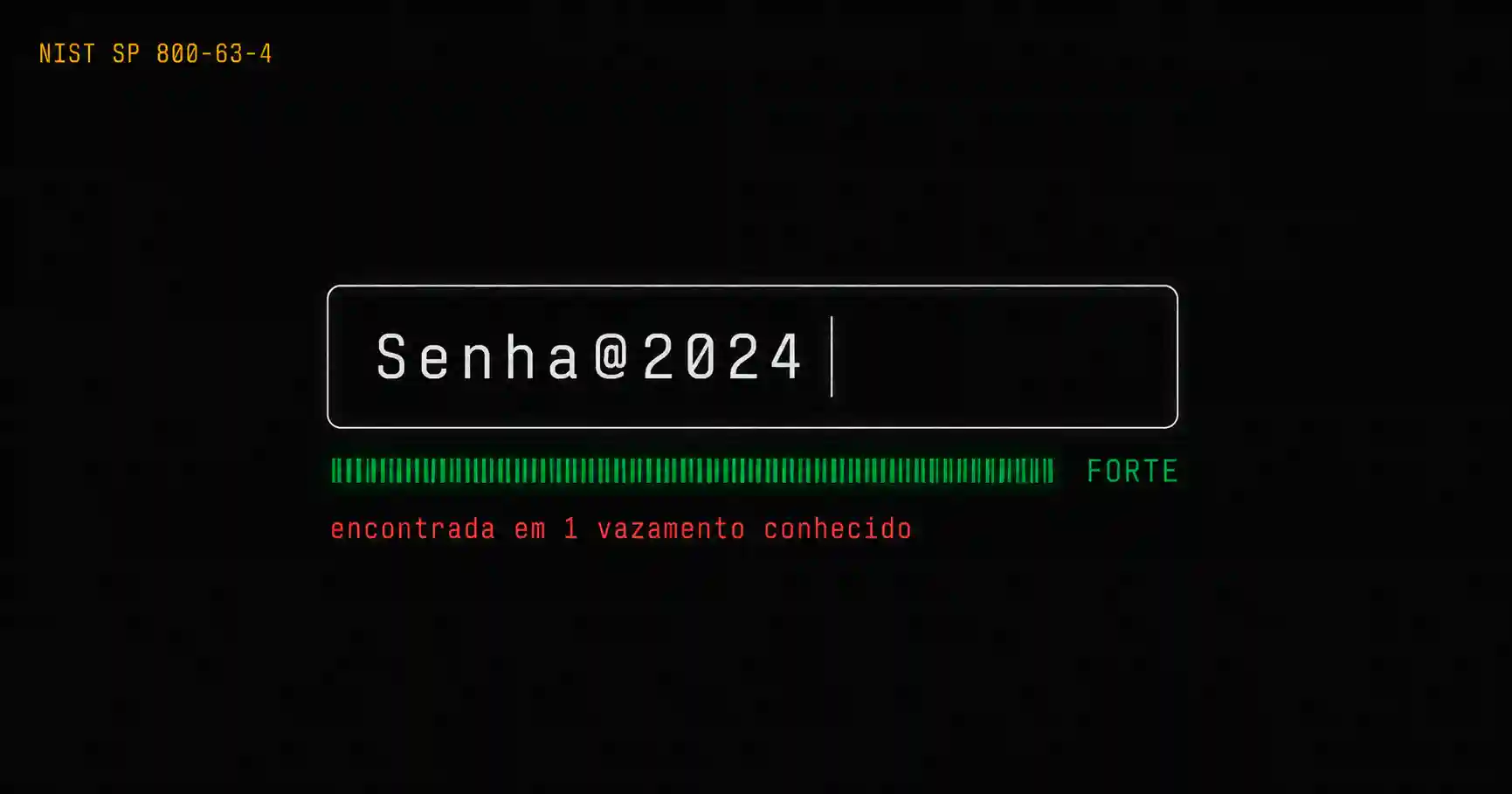
Your registration form requires an uppercase letter, a number, and a symbol, minimum length of 8 characters. The user types P@ssword1, it passes validation, goes into the database, and shows up in the next data breach. You implemented exactly what the tutorials teach — and created a policy that produces predictable passwords.
What actually makes a password strong isn't what most validators check. NIST updated its guidelines in 2024 and reversed much of the consensus the entire industry still implements by default.
Why length beats complexity
Password entropy measures the amount of randomness — the higher it is, the more combinations an attacker needs to test. The point most articles don't explain clearly: increasing length adds entropy exponentially. Increasing the character set, linearly.
An 8-character password with lowercase letters has 26⁸ ≈ 200 billion combinations. Adding uppercase rises to 52⁸ ≈ 53 trillion — a 200x increase. But going from 8 to 12 characters with only lowercase gives 26¹² ≈ 95 quadrillion — a 450,000x increase.
The practical consequence: a 16-character random lowercase password is incomparably harder to crack by brute force than P@ssw0rd!123, regardless of the special characters. Length is the variable that matters most, not the character set.
The leet speak illusion
Substituting a with @, e with 3, o with 0 seems to add complexity. To a human, it seems that way. To a password cracking program, it doesn't.
The rockyou.txt — the most used leaked password file in dictionary attacks — has 14 million entries. P@ssw0rd, S3cr3t!, @dm1n are all there. Modern cracking tools automatically apply leet substitution rules to any dictionary list. password → p@ssword → p@55w0rd → P@55w0rd! is a transformation that hashcat executes without additional configuration.
Character substitution doesn't add real entropy because it follows predictable patterns. A user who converts mypassword to myp@55w0rd thinks they created something unique. The attacker tests this variation as part of the normal flow.
What NIST changed in 2024
NIST publication SP 800-63-4, updated in 2024, is the reference the industry should be using. What it says — and what contradicts what most systems still implement by default:
Minimum length: 8 characters required, 15 recommended. The maximum must support at least 64 characters. Systems that truncate passwords at 20 or 32 characters are actively preventing secure passwords.
Complexity rules are not mandatory. NIST doesn't recommend requiring uppercase letters, numbers, or symbols. The reason is exactly the P@ssword1 effect: when you force complexity, users create predictable patterns to satisfy the validator. The result is a smaller set of real passwords than it would appear.
Mandatory periodic rotation was removed. Changing passwords every 90 days doesn't increase security — it decreases it. Users subjected to frequent rotation use Password-Jan2025, Password-Apr2025, Password-Jul2025. This is statistically worse than maintaining a long random password indefinitely. Rotation should only be required when there's evidence of compromise.
Checking against compromised password lists is recommended. Instead of complexity rules, check whether the password appears in known breaches. The Have I Been Pwned API allows this without sending the password in clear text — using k-anonymity with the first 5 characters of the SHA-1 hash.
What validation should actually check
Translating NIST guidelines into code:
async function validatePassword(password) {
  // 1. Length — the variable that matters most
  if (password.length < 12) {
    return { valid: false, reason: 'Minimum 12 characters' };
  }

  // 2. No excessive repetition (aaaa, 1111, abababab)
  if (/(.)\1{3,}/.test(password)) {
    return { valid: false, reason: 'Avoid repeated sequences' };
  }

  // 3. Check against compromised passwords via HIBP (k-anonymity)
  const hash = await crypto.subtle.digest('SHA-1', new TextEncoder().encode(password));
  const hashHex = Array.from(new Uint8Array(hash))
    .map(b => b.toString(16).padStart(2, '0'))
    .join('')
    .toUpperCase();

  const prefix = hashHex.slice(0, 5);
  const suffix = hashHex.slice(5);

  const res = await fetch(`https://api.pwnedpasswords.com/range/${prefix}`);
  const body = await res.text();
  const compromised = body.split('\n').some(line => line.startsWith(suffix));

  if (compromised) {
    return { valid: false, reason: 'This password appeared in known breaches' };
  }

  return { valid: true };
}
What this code doesn't check: whether it has an uppercase letter, whether it has a symbol, whether it has a number. Because it doesn't need to. A 16-character random lowercase password is more secure than P@ssword1! by any metric that matters.
What you probably don't want is requiring the HIBP call on every login attempt — only on registration and password change is sufficient.
Mandatory rotation: the math that doesn't work out
If you still have a system that requires password changes every 30, 60, or 90 days, the consistently measured side effect in studies is: users increment. Marco-2024 becomes Marco-2025 with a date swap. Length doesn't increase, randomness doesn't increase, and an attacker who obtained the previous password can derive the next one with high probability.
The rotation policy made sense when the main threat was someone with physical access writing down passwords. Against credential stuffing at scale and automated dictionary attacks, it's ineffective and creates real friction for the user without security trade-off.
Require rotation when there's evidence of compromise — detected breach, suspicious access in logs, or the user themselves reporting it. Not as a calendar policy.
What actually moves the needle
Three things, in order of impact.
Length. A randomly generated 20+ character password is uncrackable by brute force with current hardware. It doesn't matter whether it has a symbol or not.
Password manager. The only way to have long, unique, random passwords on dozens of services without memorizing any. Bitwarden is open source and free. This solves the human problem that no validator solves.
MFA. Even if the password leaks — and at some point it will, from some service you use — the second factor prevents access. It's the layer that compensates for inevitable human failure.
Complexity rules are the illusion of control. They make the form look more secure without making your users' passwords significantly harder to crack.
Note: the editorial content ends here. What follows is a recommendation for a tool related to the post's topic.
Related tool
To generate passwords with real length and cryptographic randomness, the Password Generator uses crypto.getRandomValues — without sending anything to a server, without registration. Useful for demonstrating to users what a properly generated password looks like.
- 01 CPU Cores vs. Threads: What Actually Changes in Practice Understand the difference between CPU cores and threads and what actually changes for performance, multitasking, gaming, and development.
- 02 MIT, Apache, and GPL Licenses: Practical Differences for Developers MIT, Apache 2.0, and GPL are not the same thing. Understand permissive vs copyleft, patent protection, and compatibility before shipping code to production.